What Google Maps Is Already Telling Us About The Odyssey Effect on Favignana
At a Glance
- 1,460 Google Maps reviews examined across three Odyssey filming locations on Favignana, as of 17 August 2026
- The Odyssey connection is clearest at Santa Caterina, with references appearing from around mid-June
- Bue Marino shows early film recognition, while none appeared in the Cala Rotonda reviews examined
- 83% rate Santa Caterina four or five stars, 42% reference the views or panorama and 19% describe the climb as worthwhile
- Google Maps reviews provide useful visitor intelligence on existing strengths, challenges and emerging screen-tourism connections
What is Google Maps already telling us?
Now one month into the release of The Odyssey, and with the film having taken around $1.29 billion at the worldwide box office, what tourism signals, if any, are showing up on Google Maps? Cinematic Tourism looked at reviews posted around filming locations on Favignana, off the western coast of Sicily, where scenes depicting Ithaca were shot in spring 2025. More specifically, are people beginning to recognise and comment on the three key locations linked to the film?
The research examined Google Maps reviews available as of 17 August 2026 and looked at comments posted around three locations: Castello di Santa Caterina, for fans of the film the instantly recognisable exterior of Odysseus’s Ithaca home; Bue Marino, the former tufa-quarry landscape used during filming; and Cala Rotonda, where some of The Odyssey’s sea filming took place.
Understandably, four weeks into the release of The Odyssey, it is still too early to draw firm conclusions from Google Maps commentary, and the reviews do not yet establish that people are travelling to these locations because of The Odyssey. What they do show, however, is that connections to the film are beginning to appear, most clearly around Castello di Santa Caterina, with some emerging references around Bue Marino and none so far around Cala Rotonda.
For Favignana, which is looking at how the film can support tourism across the wider island, weaker film connections in the reviews around Bue Marino and Cala Rotonda may also point to an opportunity to build awareness of their role in the film as part of future destination content and visitor experiences.
Why use Google Maps for research?
Google Maps provides a free and useful resource for seeing what visitors are saying about a location and, in this case of The Odyssey, whether screen-tourism associations are beginning to appear in visitor commentary. The flip side is Google Maps’ importance to visitors themselves. Recent research found that 43% of visitors to heritage destinations used Google Maps to find transport-related information while at the destination.
Google Maps is not the only tool people use, but it is important, and sits alongside official destination websites, search results, social media and other sources visitors may consult such as Trip Advisor and Reddit, when researching and planning a trip. Once on the ground, particularly when needing to make quick planning decisions about where to go, how to get there or whether somewhere is worth visiting, it can become the first, and sometimes only, sources they check.
That makes Google Maps useful from both sides: as a listening post for destinations and as a platform already embedded within the visitor journey.
Santa Caterina: where the connection appears clearest
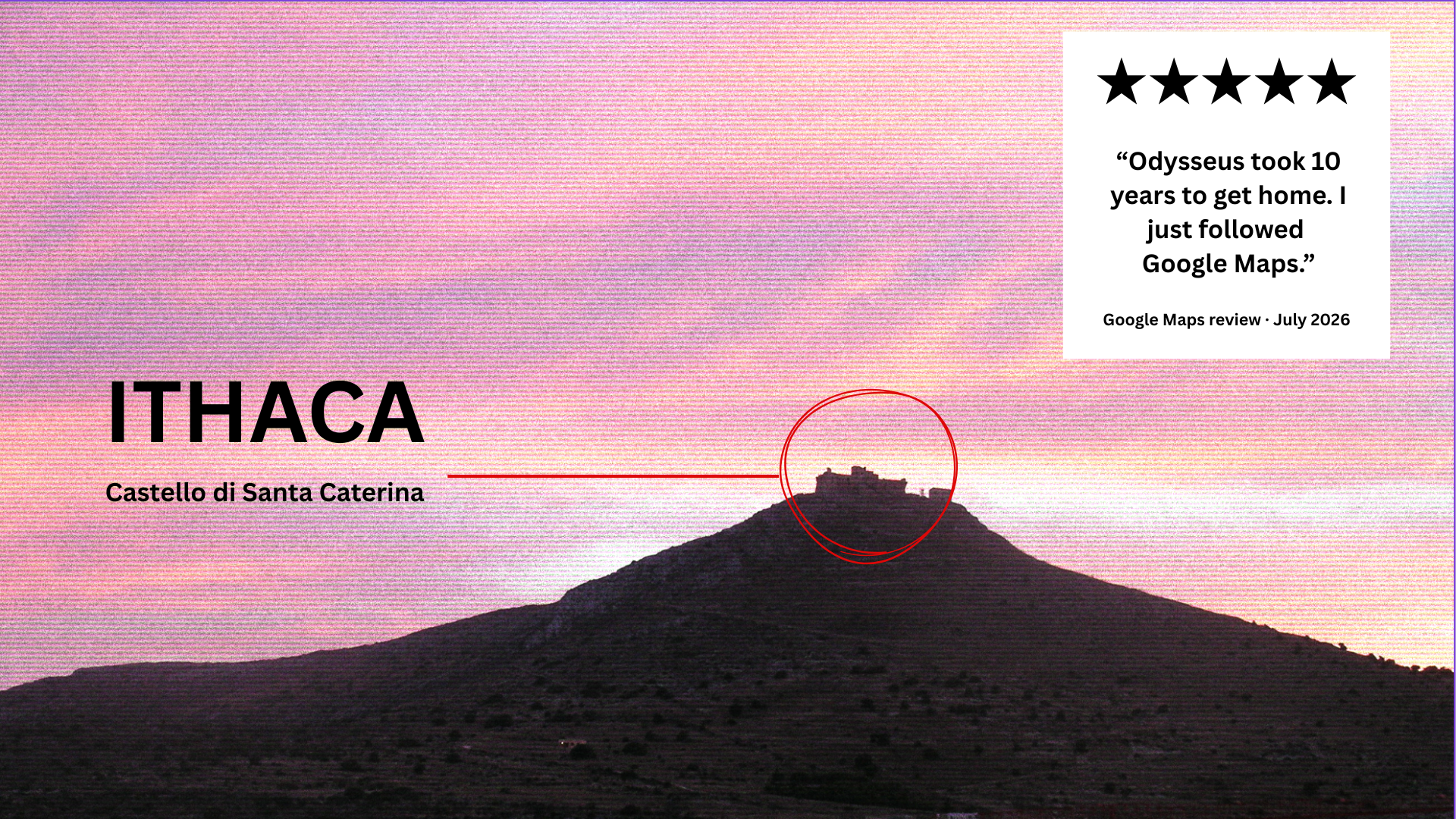
For the castle that stood in for Ithaca, there are 460 Google Maps reviews going back more than seven years. Understandably, mentions of The Odyssey, Nolan and Ithaca-related references only started appearing within the last two months, from around mid-June. There are also small but visible signs of film fans appearing in the Google Maps reviews, alongside regular visitors who are aware of the location’s connection to the film. Santa Caterina has a prominent and highly recognisable role in the film and featured extensively in trailers, posters and stills in the buzz leading up to the release of The Odyssey.
The first signals prior to release were mainly informational or observational. One reviewer acknowledged work carried out for the production, writing that “a small interior section was renovated for the filming of Christopher Nolan’s ‘Odyssey’.” Another recognised the connection while commenting on the site’s current condition, saying that “…it cannot be visited inside and was used only briefly for filming in Nolan’s Odyssey.”
Looking at comments posted around and after release, a different type of Odyssey commentary begins to appear. Some are clearly film fans having fun with the storyline and characters. From around the end of July, one wrote: “I tried to enter the castle but there were many strange men feasting inside and a weird blind man told me it would be better for me to leave.” Around a week later someone posted: “Odysseus took 10 years to get home. I just followed Google Maps,” while another wrote, “when I entered a weird guy shouted ‘somebody get these beggars out of here’, thanks to Penelope I am finally home!” More recently, in mid-August, another reviewer continued the playful references: “This is my home, my wife Penelope waited for me…”
There is no way of knowing from Google Maps alone whether all of these commentators actually visited the castle, or whether some are simply film fans finding the location and joining in with the commentary. However, four of the five fan-style reviewers examined had previously posted other Google reviews, including accounts with 127 and 71 reviews. Either way, they show fans engaging with Santa Caterina through The Odyssey. For people checking the location ahead of a visit who may be unaware of its film connection, these comments reveal another reason the castle may be worth seeing: that this is also Ithaca from The Odyssey. That discovery may encourage them to find out more about the film or give them an additional reason to visit and make the steep climb.
Alongside the playful comments are reviews that appear to describe an actual visit. One recent reviewer describes a roughly 40-minute uphill climb, recommends suitable footwear and avoiding the hottest part of the day, before adding that “if you’ve seen Christopher Nolan’s film The Odyssey, climbing that castle today also means walking through a small page in cinematic history.”
Other comments combine practical visitor information with the film connection. One reviewer wrote: “A beautiful place with free access. You can reach a certain point by scooter or bicycle. Then begins a climb, with steps to climb on foot (wear comfortable shoes). You can take beautiful photos.” They then go on to comment on the condition of the site, adding: “It’s a shame it’s abandoned and the interior is poorly maintained, despite the recent Nolan Odyssey film recently shot in the castle.”
One thing is clear: Favignana is already making a concerted effort to prepare for the potential Odyssey effect, including a planned exhibition and a wider tourism strategy. Against that backdrop, the frequency of visitor comments around access, the climb, signage and the condition of Santa Caterina provide useful intelligence on some of the practical issues that may need attention in the short to medium term.
What visitors already value at Santa Caterina
83% rate Santa Caterina four or five stars, while around 42% reference the view or panorama. This has added relevance following The Odyssey, with some of the film’s recognisable imagery showing Penelope at the castle overlooking Ithaca, giving visitors the opportunity to experience the real panorama from the location themselves.
Another strong and positive sentiment from reviews over the last seven years is that nearly one-fifth of all reviewers (19%) describe the challenging trek as worthwhile, reassuring those who may initially be put off by repeated commentary on the steepness of the climb. Additionally, more than 10% recommend timing the climb for sunset or sunrise to experience the panorama at those times of day.
Bue Marino: Odyssey Connection Is Starting to Show
At Bue Marino, where the former tufa-quarry landscape was used during filming, 500 Google Maps reviews were examined going back around three years. Unlike Santa Caterina, Odyssey references remain very limited, with just two explicit references identified so far, both posted after the film’s release. One visitor, writing in early August, described the former quarry and added that “even Nolan chose it for his film The Odyssey.”
Another recent review provides perhaps a more interesting indication of where the screen-tourism opportunity lies for this location. The visitor describes the turquoise sea, fossils, layers of stone and “temple like corridors”, before saying that “having watched the new Odyssey movie it felt so much more epic and familiar.” Importantly, they add: “we didn’t know they actually recorded the movie there and that Favignana was the location for Ithacca.”
It doesn’t indicate that The Odyssey drove the visit, but it does show how discovering the screen connection can enrich the experience and create an additional emotional connection to the place. For the Municipality of Favignana, there is an opportunity to strengthen awareness of Bue Marino’s role in The Odyssey as part of its wider tourism strategy.
Cala Rotonda: No Direct Connection in the Reviews
At Cala Rotonda, where some of The Odyssey’s sea filming took place, 500 Google Maps reviews were examined, with no explicit references identified mentioning Nolan or The Odyssey. Interestingly, visitors regularly call out the distinctive Arco di Ulisse, or Ulysses’ Arch, often describing it as one of the defining features of the cove. What isn’t appearing yet is a connection between this already recognisable landmark, the wider filming that took place at Cala Rotonda and The Odyssey. Just one month after release, that is perhaps unsurprising, but it points to a further opportunity for Favignana to help visitors make that connection.
Google Maps Reviews as an Early Listening Tool
While it is still too early to say that Google Maps shows evidence of people travelling to Favignana because of The Odyssey, the reviews provide an early snapshot of how the film is beginning to enter visitor commentary around the island. This is most apparent at Santa Caterina and, to a lesser extent, Bue Marino, while at Cala Rotonda reviewers have yet to make the same direct film connection. Some of the commentary is playful fandom, which may skew the picture, while other reviews are starting to connect the film directly with the experience of visiting the locations.
More widely, Google Maps reviews provide organic commentary, useful visitor intelligence and insight into sentiment, highlighting what people already value about these places alongside some of the recurring challenges they encounter. For Favignana, and other destination marketers, this can provide additional insight to help inform and strengthen a screen-tourism campaign that builds on what already draws visitors to a location, while being aware of the practical issues they raise.