What began as a spectacular opening sequence in the 2015 James Bond film Spectre helped inspire a real-world event in Mexico City. Ten years after the inaugural parade in 2016, the story offers an example of how cinema can influence a destination’s cultural amd tourism offering.
When Spectre opened in cinemas in November 2015, audiences globally were treated to a thirteen minute opening scene before the famous title credits, set this time in the heart of the Día de Muertos (Day of the Dead) celebrations. Bond films are known for their highly choreographed and dramatic openings, often in exotic locations and for many film fans this film did not disappoint.
In Spectre this included a continuous tracking shot that follows skeleton-costumed James Bond moving through a vast Day of the Dead procession in Mexico City’s historic centre before pursuing an assassin across rooftops and into a helicopter above the Zócalo.
The film gave Día de Muertos substantial international exposure, presenting audiences with a spectacular annual parade through Mexico City’s historic centre. Yet when Spectre was released, no such large-scale parade existed in the capital. For international viewers unfamiliar with the city’s celebrations, there was little to indicate that the procession had been created for the film.
Día de Muertos was already celebrated across Mexico through local processions, offerings and community traditions. Fast forward to 2026, and that fictional spectacle has become an established part of Mexico City’s cultural calendar and a major visitor attraction. Yet the extent to which Bond inspired its creation remains disputed. So how did the parade come about?
A year later, on 29 October 2016, Mexico City turned film fiction into reality and staged its first grand Day of the Dead parade. The 2026 edition is expected to feature thousands of participants and tributes to Mexican cultural figures.
Was Bond Really the Sole Influence
Mexican tourism officials certainly recognised the potential of James Bond films to generate interest in their locations. With Mexico City featuring so prominently in Spectre’s opening sequence, the film certainly presented an opportunity for the local authorities to use this global exposure and cultural cache of being featured in a Bond to attract visitors. There are however differing accounts of how the modern parade was conceived, and if a myth has developed around Bond inspiring the creation of the parade, at the expense of overlooking Mexico’s own cultural traditions.
Speaking back in 2016, Lourdes Berho, then chief executive of the Mexico Tourism Board, confirmed the film giving them a push to do something, and said the film had created expectations among international audiences that such a parade existed. Tourism officials saw an opportunity to turn that fictional spectacle into a real attraction. The Mexico Tourism Board also launched an international Day of the Dead promotional campaign in October 2016, linking the inaugural parade to wider efforts to attract visitors to Mexico.
The then mayor, Miguel Ángel Mancera, openly credited Spectre with inspiring the parade, while his culture secretary, Eduardo Vázquez, challenged the idea that the celebration originated with Bond. He pointed to the city’s existing Day of the Dead activities, including monumental offerings in the Zócalo and earlier processions featuring Catrinas.
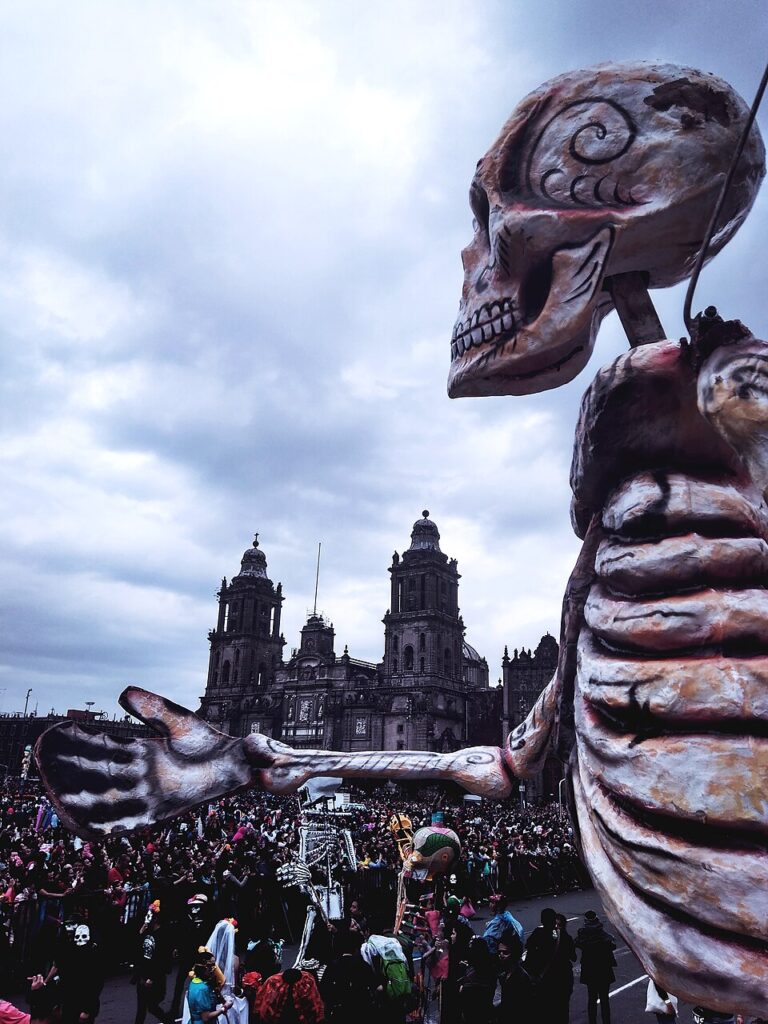
The original Spectre production notes offer a useful perspective on the filmmakers’ intentions. Director Sam Mendes said the team wanted to immerse Bond in a spectacular festival in a Latin American city, settling on Mexico City and Día de Muertos for its scale and visual impact. Production designer Dennis Gassner, who had long followed the celebrations, described researching their traditions and working with Mexican collaborators to create the fictional procession. Its centrepiece was a giant La Catrina, the elegantly dressed skeleton figure originating in the satirical work of Mexican illustrator José Guadalupe Posada, complete with a hat ten metres across.
Whatever its inspiration, staging the inaugural parade in 2016 required collaboration between the city’s cultural and tourism authorities, educational institutions and local artists, with around 1,200 volunteers involved. Two giant figures originally created for Spectre were incorporated into the real parade, providing a tangible connection between the film and the new event.
A decade later, La Catrina remains prominent in Mexico City’s celebrations. For the parade’s tenth anniversary in 2026, a 32-metre sculpture of the figure was installed in the Zócalo as part of the city’s monumental Day of the Dead offering.
Ultimately, Spectre brought considerable creative licence to its depiction of Día de Muertos, but the traditions and imagery it drew upon were already deeply established in Mexican culture. Rooted in Indigenous practices and later Catholic influences, the celebrations have centuries of history. Bond may have helped inspire Mexico City’s modern grand parade, but neither the festival nor its most recognisable symbols began with the film.
Spectre: How Much Screen Time Did Mexico City Get?
Mexico City’s appearance in Spectre is concentrated in its spectacular pre-title sequence, lasting approximately 12 minutes, or 8.1% of the film’s 148-minute running time. That was comparable to Skyfall’s 12.5-minute opening chase through Istanbul, and considerably longer than the historical Bond average of approximately seven minutes, according to a Blu-ray timing analysis published by Dutch James Bond fan website James Bond Nederland.. Elsewhere in Spectre, Rome features in a narrative stretch of approximately 22 minutes, the Austrian Alps 24 minutes and Morocco 42 minutes, although these sequences include cuts to other locations and do not represent uninterrupted screen time. Mexico City’s relatively brief appearance is particularly striking given its memorable opening sequence and lasting association with the city’s annual Day of the Dead parade.
Behind the opening sequence · 2015
Making Spectre in Mexico City
The production behind Bond’s Día de Muertos opening, and what local authorities reported while the cameras were rolling.
The production
During filming · city-reported figures
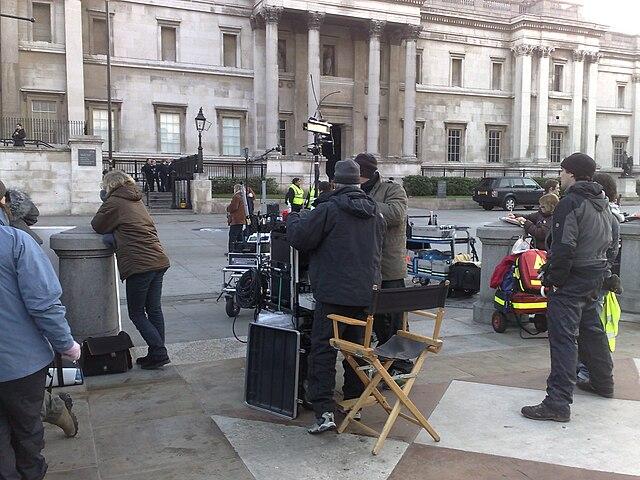
Filming Spectre‘s opening sequence in March 2015 required months of preparation and approximately ten days of shooting in Mexico City’s historic centre. More than 1,500 extras brought the fictional Día de Muertos procession to life, while Mexican production partner Redrum helped coordinate the complex location work around the Zócalo, including the helicopter sequence.
The shoot was also contentious. Businesses complained about disruption from street closures, and the financial support used to attract the production drew scrutiny. City officials offered a different account of its immediate effects, reporting a 53% rise in visitors to the historic centre and a 30% increase in hotel accommodation activity during filming. Those figures reflect the authorities’ assessment at the time, not independently verified tourism gains attributable to the film.
Sources and qualifications: Production figures draw on published Spectre production information; the local jobs estimate was reported by Mexican tourism authorities. The US$18m figure concerns reported tourism-promotion support, not verified local production expenditure. The 53% visitor and 30% hotel figures were reported by Mexico City’s economic development department in April 2015; their comparison periods have not been independently established.
Ongoing Debate Carries: Bond vs Benefit to Local Communities
The debate over Bond's influence, and whether tourism growth benefits local communities, continues today. Speaking to El País México in October 2026, María Angélica Galicia Gordillo, an anthropologist at Mexico's National Autonomous University (UNAM), warned that large urban celebrations risk prioritising tourism over traditional remembrance, although she welcomed the renewed popularity of Mexican cultural imagery among younger generations. Art historian Veka Duncan offered a broader historical and societal perspective, arguing that Día de Muertos has continually evolved over the years through religion, politics and popular culture. From that perspective, Bond and Spectre’s influence, and wider screen induced tourism, represent another influence of many, on a tradition that has never stood still and is every evolving.
For destination marketers, the more interesting story is not whether Bond invented the parade, but how a fictional cinematic spectacle evolved into a celebration with an identity of its own.
Beyond Bond: What Do the Tourism Figures Show?
The successful growth of Mexico City's Day of the Dead parade is evident in the official attendance figures. From around 250,000 spectators at its inaugural edition in 2016, the event attracted more than one million the following year. By 2025, city authorities reported an audience exceeding 1.45 million.
The wider celebrations have also become a firm part of the wider capital's visitor economy. According to Mexico City's Tourism Secretariat, more than 231,000 tourists stayed in the city's hotels during the 2025 Día de Muertos period, an increase of 5% on the previous year. Hotel occupancy reached 82%, while reported economic activity totalled approximately MX$2.24 billion.
Whilst these figures suggest a substantial tourism opportunity, as the Mexican Grand Prix takes place around the same period, it does make it difficult to separate demand generated by the parade from other events and the wider holiday celebrations.
For the 2026 celebrations, city authorities forecast more than 500,000 visitors and approximately MX$12 billion in economic activity across the capital. The parade itself is expected to involve more than 4,000 participants, 12 floats and two monumental balloons.
The tourism legacy · 2016–2026
Ten years of the Día de Muertos parade
How the parade grew
2016
250,000+
First parade
2017
1m+
Second edition
2024
1.3m
Reported attendance
2025
1.45m+
Reported attendance
Selected years only. These are reported crowd estimates, including local spectators, rather than counts of tourists. The bars compare the reported scale of each edition.
The wider Día de Muertos economy
Sources and scope: Parade attendance figures are reported estimates. Economic activity and hotel projections cover the wider Día de Muertos celebrations, not the parade alone. The 2026 figures are forecasts, not final results. The estimates do not establish economic activity caused directly by Spectre. Sources: El Universal / Mexico City government and Canaco CDMX .
Beyond the Parade: What Do the Hotel Figures Tell Us?
The parade has grown considerably since its introduction in 2016, but has that popularity translated into more overnight visitors? Mexico City's hotel figures offer a more complicated picture.
According to the Mexico City Secretariat of Tourism, 70.5% of the city's hotel rooms were occupied during October 2014, before Spectre was released. That rose to 74.1% in 2016, the parade's first year, and 77.2% in 2017. By October 2024, the figure was 69.2%. The city's October 2025 figure is not yet available in the published data, but separate federal tourism statistics put occupancy at 65.8%, up from 64.6% in 2024. The federal figures use a different reporting basis, so they cannot be directly compared with the earlier city figures.
Mexico City also has considerably more hotel rooms than it did a decade ago. The number officially recorded rose from 50,190 in 2014 to 62,279 by July 2025.
But with more hotel rooms available, are more of them actually being filled? To find out, we multiplied the number of available rooms by the October occupancy rate for each year. Using the 2014 and 2024 figures, that gives us an estimated 35,400 occupied rooms per night in 2014 and 42,400 in 2024. That's around 7,000 additional occupied rooms each night, or nearly 20% more than in 2014. The calculation already takes account of the increase in available hotel rooms.
There is one important qualification. In 2023, Mexico City started counting some existing hotels that had previously been left out of its figures. This means part of the apparent increase may reflect more complete records rather than additional hotel demand.
The figures therefore suggest that more hotel rooms are being occupied than a decade ago, despite the lower occupancy percentage. But while the parade has become a major attraction, these city-wide statistics cannot tell us how much of that additional hotel activity, if any, is directly linked to the Day of the Dead celebrations.
Explore the data
October hotel occupancy (%)
October city series through 2024. The 2025 hollow marker is from a separate federal series and is not directly comparable.
Recorded hotel rooms
2025 is July, not October. In 2023, previously uncounted existing hotels were added to the register.
Reported parade attendance
Main-parade attendance estimates from published reporting. Figures and counting methods vary; no street parade took place in 2020.
Same years, separate scales. Compare when changes happened, not the size of the numbers.
October hotel occupancy (%)
Recorded hotel rooms
Reported parade attendance
2020: no street parade. 2025 occupancy uses separate federal figures; 2025 room total is from July. Parade figures are estimates.
Sources and scope: Mexico City Secretariat of Tourism (hotel occupancy and rooms); July 2025 bulletin; DataTur October 2025. Parade attendance compiled from city and federal reporting and contemporary coverage; not a single uniform counting series. The 2019 figure (807,000) refers to the main parade rather than a separate international procession. Figures are estimates, not tourist counts.
From James Bond to Coco: Who Tells Mexico's Story?
Roberto Montalvo, a specialist in marketing and hospitality management, examined how Spectre and Pixar's Coco have influenced international perceptions of Día de Muertos in Universidad Iberoamericana article (October 2026)
Montalvo recognised the opportunities that film exposure creates for tourism, but warned against allowing commercial interpretations to overshadow the cultural practices behind the celebrations. Rather than rejecting Hollywood's influence, he argued that Mexico could use international interest to introduce visitors to the diversity of its regional traditions, including community celebrations and lesser-known cultural practices.
For destination marketers, his argument raises a question beyond just attracting visitors: how can the international exposure and promotion that films bring to locations and cultural traditions be used to support the communities that make those destinations distinctive?
The James Bond Tourism Push Study
A 2024 study by researchers at the University of Vigo and Polytechnic University of Leiria, Film-Induced Tourism as a Key Factor for Promoting Tourism Destination Image: The James Bond Saga Case, identified 77 Bond-associated destinations across 37 countries. At the time of their study, just 26% incorporated Bond references into their official tourism websites. Switzerland's national tourism website returned 29 Bond-related results, including eight visitor experiences and seven routes, while VisitBritain reported that its Skyfall promotional campaign reached 653 million people worldwide.
The researchers found no equivalent Bond references on the official Mexico City tourism website examined in March 2024, despite the city's role in establishing the parade. However, the findings reflect the study's specific website-search criteria, rather than the full extent of destination promotion. With the parade marking its tenth anniversary in 2026, the results may also have changed.
The James Bond Effect: From Jamaica to Mexico City
James Bond's influence on tourism stretches back to the franchise's earliest days. Jamaica, the setting for Dr. No (1962), remains closely associated with 007 more than six decades later. In September 2026, over 40 international Bond enthusiasts travelled to the island for a ten-day tour of filming locations, coinciding with the launch of Simon Firth's book Jamaica: On the Tracks of James Bond.
Elsewhere, Thailand's Khao Phing Kan remains internationally known as James Bond Island following The Man with the Golden Gun (1974), while Switzerland's Schilthorn has developed permanent Bond-themed attractions around On Her Majesty's Secret Service (1969). In Udaipur, India, some restaurants still screen Octopussy (1983) for visitors more than four decades after its release.
Mexico City offers a different example of the Bond effect. Rather than simply encouraging visitors to explore a filming location, Spectre helped inspire a new annual event that has since developed a cultural and tourism identity of its own.
Two comparisons: how long four locations feature in Spectre, and how its opening sequence compares with earlier Bond films.
How long does each location feature in Spectre?
Approximate narrative time associated with four locations in the 2015 film.
Reference: Ext.Street’s Spectre scene and location breakdown. The figures are approximate estimates of narrative windows derived from scene chronology, not totals published by Ext.Street or independently verified location screen time. Sequences may cut elsewhere.
How long are Bond's opening sequences?
Twelve films across the franchise, timed before the main titles. Spectre is highlighted.
Historical average across all 23 films in the source: approximately 7 minutes.
The evolution of the Bond pre-title sequence
Bond’s opening sequences have varied considerably over the decades. From Russia with Love (1963) lasted just 2 minutes 38 seconds, while The World Is Not Enough (1999) set a record of 13 minutes 48 seconds that stood for 22 years, until No Time to Die (2021) extended the format to nearly 24 minutes. At 12 minutes 1 second, Spectre’s Mexico City opening was therefore in keeping with the longer action-led introductions of the modern Bond era, rather than an unprecedented departure from the franchise’s conventions.
Source: Jasper Hartog, James Bond Nederland, “Sequence Smaakmakers” (2020). Timings are from Blu-ray editions, from the end of the gun-barrel sequence to the first frame of the main titles. The 12 films shown are a selection from the 23 timed by the author; No Time to Die (2021) is not included.